

By Dean Murray
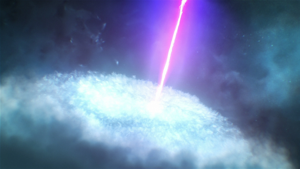
Space scientists have released jaw-dropping visuals of a black hole eating a star.
Astronomers were puzzled after a record-breaking cosmic event saw the longest gamma-ray burst (GRB) ever observed.
Discovered on July 2, it has been described by Rutgers University as “one of the universe’s strangest explosions.”
While most GRBs last only a minute, this one continued for days, and astronomers have been poring over a flood of data from NASA satellites and other facilities as they try to work out what was responsible.
NASA reported Monday, Dec. 8, that researchers have been discussing their findings and agree that the unprecedented burst, named GRB 250702B, likely heralds a new kind of stellar explosion.
Scientists say the best explanation for the outburst is that a black hole consumed a star, but they disagree on exactly how it happened.
NASA said: “Exciting possibilities include a black hole weighing a few thousand times the Sun’s mass shredding a star that passed too close to it or a much smaller black hole merging with and consuming its stellar companion.”
Eliza Neights, of George Washington University and NASA, said: “The initial wave of gamma rays lasted at least 7 hours, nearly twice the duration of the longest GRB seen previously, and we detected other unusual properties.
“This is certainly an outburst unlike any other we’ve seen in the past 50 years.”
Neights and other astronomers shared their results in October at the American Astronomical Society’s High Energy Astrophysics Division meeting in St Louis, Missouri. A variety of papers on the event have been published or accepted, and more are being prepared.