

By Faye Minton & Faye Mayern
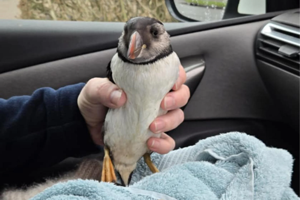
A little puffin blown hundreds of miles off course by recent storms has been rescued by a dog walker from a beach in the south of England.
Sonia Meachen, from Dereham, Norfolk, was walking her dog Ernie at nearby Gorleston when she saw the small bird.
She managed to scoop the Atlantic puffin up in her hat and called an animal rescue charity to collect the bird.
The RSPCA said the bird was extremely weak and sadly they are not optimistic about its survival.
Puffins are not commonly found along the Norfolk coast – preferring the cliff faces of Skomer Island in Wales.
Meachen, who initially believed the bird was female, said: “I just couldn’t believe it.
“Her wings were out, but she couldn’t fly. She let me pick her up with my hat.
“As I got to the car park at the top of the cliff, there was a coffee van and some people were gathered around it.
“The gentleman who owns the coffee van contacted Dan Goldsmith from Marine and Wildlife Rescue – he came straight away.”
Goldsmith said it is the first puffin the charity has ever come across.
The seabirds usually live in the cold waters of the North Atlantic and North Pacific Oceans.
When they are seen in the UK, they are often in northern England, Scotland and Wales.
Goldsmith explained: “A few have shown up across this region in the past, but unfortunately, they are normally deceased.
“This bird was somewhat cold and exhausted as a result of being battered by the sea.
“Most wild animals have challenges to overcome as part of their onward rehabilitation so hopefully if it builds its strength and has no lasting damage, it can make a full recovery.”
The puffin, which was later identified as male, has been taken to the RSPCA centre at East Winch, near King’s Lynn, for further care.
An RSPCA spokesperson said: ““We are grateful to everyone who helped this poor Puffin.
“He is under veterinary supervision and we are doing all we can to save him, but the puffin is extremely thin and very weak, so his prognosis at the moment is very guarded.”
They are listed as a red status in the UK, which means they are a species of high conservation concern.
Living exclusively in coastal areas, they live on a diet of fish, with sand eels a particular favourite.
According to the RSPB, there are around 580,000 UK breeding pairs.