
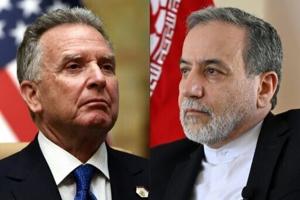
US special envoy Steve Witkoff has spearheaded talks on Gaza and Ukraine, while Foreign Minister Abbas Araghchi is Iran’s face abroad.
On Friday, they meet in Muscat following a deadly crackdown on a mass protest movement against the Islamic republic that saw the United States threaten military action before agreeing to talks.
Here are short profiles of the two lead negotiators:
– Witkoff: real estate to world stage –
With no prior experience in foreign policy, he landed one of the world’s biggest jobs as US President Donald Trump’s special envoy, and has since led talks on Gaza and Ukraine.
Real estate magnate Witkoff first stepped into the spotlight when his close friend Trump credited him with sealing what ended up being a short-lived truce in the Israel-Hamas war.
He also took part in previous high-level talks with Iran over its nuclear programme last year — abruptly ended by Israel’s 12-day war against the Islamic republic, which the US briefly joined.
Witkoff and Araghchi met at those discussions, which also took place in Oman.
A 68-year-old billionaire and a regular golfing partner of Trump’s, Witkoff later became the first US official to visit Gaza since the war began with Hamas’s 2023 attack on Israel.
Fast-forward to October 2025, when Trump took all the credit for brokering the deal that finally brought the Gaza war to a halt, it was Witkoff and the president’s son-in-law and emissary Jared Kushner who thrashed out the US position and ultimately got an agreement over the line.
Witkoff has also spearheaded negotiations on Ukraine and was, ahead of the discussions with Iran, in Abu Dhabi for the latest round of talks on the Ukraine war.
With Trump U-turning on his predecessor Joe Biden’s policy on Russia, Witkoff has drawn criticism from Ukraine’s leader Volodymyr Zelensky over his praise for Russian President Vladimir Putin, whom he has travelled to Moscow multiple times to meet.
Trump has made it a foreign policy goal to end wars that Biden could not, meaning that the stakes could hardly be higher for Witkoff.
Born on March 15, 1957, in the New York borough of the Bronx, Witkoff made his fortune in real estate, first as a corporate lawyer and then at the head of big realty firms.
In 1997, he founded the Witkoff Group, which describes itself as “one part developer, one part investor (and) one part landscape-changer”. His wife and a son work there.
– Araghchi: Iran’s career diplomat –
A career diplomat and key architect of a now-defunct 2015 nuclear accord, Araghchi will be pushing the United States to lift its sanctions on Iran.
The 63-year-old, who hails from a family of carpet traders, is fluent in English and has a long career spanning multiple roles in Iran’s foreign ministry.
With his crisp beard and salt-and-pepper hair, Araghchi is known for his cool demeanour, and typically wears a suit and a tie-less white mandarin-collared shirt, a standard look among Iranian diplomats.
While he eschews the clerical tone that dominates the upper echelons of the Islamic republic, Araghchi played an important role last month representing the leadership to the outside world during a deadly crackdown on mass protests.
While the top leaders and security forces crushed the movement, Araghchi justified the crackdown by speaking to broadcasters and newspapers everywhere, even publishing an op-ed in the Wall Street Journal.
Araghchi holds a bachelor’s degree from the foreign ministry’s Faculty of International Relations, a master’s in political science from the Islamic Azad University, and a doctorate in political thought from the University of Kent in England.
Following the 1979 Islamic revolution, Araghchi joined the Islamic Revolutionary Guard Corps.
He served on the front lines during the Iran-Iraq war in the 1980s before joining the foreign ministry as an expert on international affairs.
Araghchi was appointed foreign minister after President Masoud Pezeshkian took office in July 2024, in part to help repair ties with the West — with which he was well acquainted after negotiating the landmark 2015 deal that imposed curbs on Iran’s nuclear programme in return for sanctions relief.
But Iran’s relations with European countries in particular have deteriorated under his watch after he lambasted them for failing to condemn Israel’s war against the Islamic republic last June.
They soured further when France, the United Kingdom and Germany moved at the end of September to reinstate international sanctions on Iran over what they described as its non-adherence to the nuclear deal.
The accord, known as the Joint Comprehensive Plan of Action (JCPOA), had been left in tatters after the United States, during Trump’s first term, unilaterally withdrew from it and reimposed sweeping economic sanctions.
burs-ser/smw