
By Faye Mayern
The skull of a Viking-era man who had part of his skull cut out in the world’s oldest surgical procedure has been unearthed.
The remains of a man between 17 and 24 revealed a large oval hole in his skull, measuring three cm in diameter from around the 9th century AD.
Archeologists believe he may have undergone trepanation – an ancient surgical procedure in which a hole is bored through a living human’s skull for migraines or seizures.
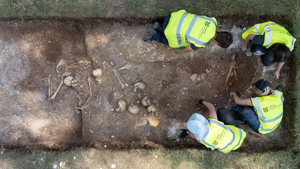
The find was found during a University of Cambridge training dig for students outside the city last year at the Iron Age hillfort in Wandlebury.
The man’s height stood at around six foot and five inches tall while the average male height at the time was five foot six.
Dr. Trish Biers, curator of the Duckworth Collections at the University of Cambridge, said: “The individual may have had a tumour that affected their pituitary gland and caused an excess of growth hormones.
“We can see this in the unique characteristics in the long shafts of their limb bones and elsewhere on the skeleton.”
“Such a condition in the brain would have led to increased pressure in the skull, causing headaches that the trepanning may have been an attempt to alleviate.
“Not uncommon with head trauma today.”
The inclusion of dismembered remains alongside fully articulated bodies is highly unusual even for a mass grave, and has puzzled archaeologists.
The archaeological remains are believed to have been from the aftermath of a battle or execution from around the 9th century AD.
Unusually, the mass grave held a mix of complete and dismembered remains, including a cluster of skulls without clear accompanying bodies and a “stack of legs”.
Four complete skeletons were also unearthed – some in positions suggesting they were tied up.
All appear to have been relatively young men flung into the pit without care, leading archaeologists to believe they found the wake of a skirmish or battle, or perhaps a mass execution.
Cambridge Archeologic Unit’s Dr. Oscar Aldred added: “Those buried could have been recipients of corporal punishment, and that may be connected to Wandlebury as a sacred or well-known meeting place.”
“It may be that some of the disarticulated body parts had previously been displayed as trophies, and were then gathered up and interred with the executed or otherwise slaughtered individuals.
“We don’t see much evidence for the deliberate chopping up of some of these body parts, so they may have been in a state of decomposition and literally falling apart when they went into the pit.”