
The United States said it launched an operation Wednesday that could move thousands of Islamic State group jihadists from Syria to Iraq, as Syrian and Kurdish-led forces traded accusations of breaching a fragile ceasefire.
The move came a day after Washington said the purpose of its alliance with the Syrian Kurds had largely ended, with the US now backing Syria’s Islamist authorities who are seeking to extend their grip on the country after years of civil war.
Syria’s army entered the vast Al-Hol camp that houses suspected IS relatives on Wednesday after the Kurdish-led Syrian Democratic Forces (SDF) withdrew, an AFP journalist at the scene said.
The SDF, backed by a US-led coalition, battled the jihadists to their territorial defeat in Syria in 2019.
During the fighting, the Kurds seized swathes of territory, jailed some 12,000 members of the group — including up to 3,000 foreigners from more than 50 countries — and detained tens of thousands of their relatives in camps in the northeast.
The US military said Wednesday it had launched an operation to move 7,000 IS prisoners from Syria to Iraq.
The aim of the operation — which began with the movement of 150 IS fighters — is to “help ensure the terrorists remain in secure detention facilities,” US Central Command said in a statement.
Aaron Zelin, a senior fellow at the Washington Institute for Near East Policy, said on X that the move suggested the US military didn’t think “the situation is stable enough to keep them there”.
Damascus’ forces have taken control of swathes of formerly Kurdish-held territory in the north and east.
That has included a deal struck over the weekend between the two sides that will see the Kurds’ administration integrated into the state, while the government will take responsibility for IS prisoners.
– ‘Living a tragedy’ –
Damascus and the Kurds traded accusations of attacks despite a truce announced Tuesday.
The defence ministry said an SDF drone strike targeted an arms factory that its forces found in Hasakeh province, causing a blast that killed seven soldiers.
It said a total of 11 people had been killed since the ceasefire.
The army condemned the incident as “a dangerous escalation and clear violation of the ceasefire”.
The SDF denied attacking the factory, saying “an accident during the transfer of ammunition by Damascus factions” caused the blast.
It said it was committed to the truce, which ends Saturday evening, and accused the government of carrying out “a series of attacks”, one of which killed a woman near Kobane, also known as Ain al-Arab, on the border with Turkey.
Kurdish forces drove IS from Kobane in 2015 and the city became a symbol of their victory against the jihadists.
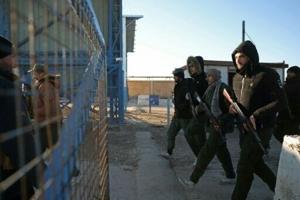
Soldiers opened the metal gate at the Al-Hol camp on Wednesday and entered while others stood guard, as women and children milled among the tents.
“We’ve been living a tragedy,” said Umm Sadek, 33, wearing the Islamic full-face niqab veil.
“I hope the new government will show mercy and compassion,” she told AFP, denying any links to IS.
Ibrahim Ibrahim, 18, said he was 10 when he arrived at the camp, where he lives with his family.
“I hope to get out of here, work, support my family and get married… I hope the government will release us,” he said.
– Waiting for news –
Thousands of former jihadists, including many Westerners, are held in Kurdish-run prisons in northeast Syria, while thousands more of their suspected family members live in the Al-Hol and Roj camps.
In a desert region of Hasakeh province, the sprawling Al-Hol holds around 24,000 people, including some 6,200 women and children from around 40 nationalities.
In Raqa province, an AFP correspondent saw people waiting for news of family members held in Al-Aqtan prison, where government forces deployed a day earlier but where a security official told AFP that Kurdish forces were still inside.
Hilal al-Sheikh, from a village in the province, said he had been waiting for days for news of his 20-year-old son, jailed for 10 months.
“The SDF terrorist gangs arrested” him in the middle of the night, Sheikh said.
“They accused him of terrorism… before sentencing him to five years in prison,” he added.
On Tuesday, the interior ministry said 120 IS members escaped from the Shadadi prison in Hasakeh province, later saying it had arrested “81 of the fugitives”.
Syria’s presidency on Tuesday announced an “understanding” with the Kurds over the fate of Kurdish-majority areas of its Hasakeh province stronghold, and gave them “four days for consultations to develop a detailed plan” for the area’s integration.
If finalised, government forces “will not enter the city centres of Hasakeh and Qamishli… and Kurdish villages”, it added.
strs-lk/lg/jfx