

A growing number of travelers are choosing where to go based on where they have already been. A recent survey by Contiki found that 55 percent of its Gen Z and Millennial audience has a nostalgia-driven trip on their wish list, most often a return to a place first visited in childhood. Industry forecasts suggest that impulse will only deepen in 2026, as travelers increasingly look backward for comfort while cities race forward around them.
Travelers are gravitating toward historic city hotels for the familiarity they offer. Rather than serving as monuments to the past, these properties are becoming places of return, selected for the way they hold personal and collective memory at once.
“There is a comfort in staying somewhere that already feels known,” said luxury travel writer Karee Blunt. “Landmark hotels carry memory, both personal and shared, and that familiarity matters more when the world feels unsettled.”
Nearly a century after it opened, the Fairmont Royal York, a Virtuoso property, continues to draw guests for a reason that has little to do with novelty.
Iconic View
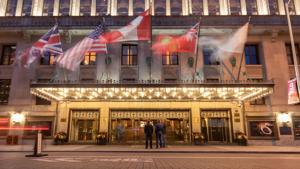
I used to look across Front Street at the Fairmont Royal York from the steps of Union Station as a young girl, wondering what it felt like to belong inside. The hotel’s green copper roof caught the light even on gray days, its limestone façade towering over the tracks where my train rides began. In the 1980s, Toronto still felt like a city becoming, and the Royal York was grand, self-assured, and slightly mysterious.
When the Blue Jays won the World Series in 1993, I was one of thousands who spilled into the streets outside, the city pulsing with noise and joy. We passed beneath the hotel’s glowing marquee, where guests peered out from the windows above Front Street. Even then, it felt like the Royal York stood watching the city’s moments unfold as it had since 1929.
In the decades since, Toronto has grown skyward around it. The CN Tower, once the world’s tallest structure, is now surrounded by glass towers that mirror the Royal York’s stone exterior. Today, the Fairmont Royal York employs more than 1,200 people and welcomes about 1.5 million guests a year.
The Royal York belongs to a larger Fairmont legacy spanning 94 hotels across 30 countries, each serving as a social anchor in its city. In Toronto, that spirit gathers daily along Front Street, where travelers, locals, and history meet beneath a frontispiece that continues to welcome them home.
Then and Now
When the Royal York opened on June 11, 1929, it ranked among the largest hotels in the British Empire, with 1,048 rooms, each equipped with a telephone, radio, and private bath — a level of comfort that Canadian Pacific promoted as state-of-the-art.
Canadian Pacific built the Royal York at the height of the jazz age, when train travel carried the glamour of a Cary Grant film and a cross-country ticket promised adventure. Passengers stepped off the platforms of Union Station and crossed Front Street into a hotel that matched the optimism of a nation determined to dazzle the world.
Nearly a century later, its brass doors open to a lobby that manages to feel half Gatsby, half contemporary in Toronto. Beneath the coffered ceilings, it’s as if the Jazz Age soirées have quietly stepped into the Instagram era.
Upstairs, the Fairmont Gold floor has all the feels of a penthouse wing. Guests check in at a private desk on the 18th floor and have access to the Gold Lounge with skyline views stretching toward Lake Ontario. Mornings begin with croissants still crisp from the oven, smoked salmon beside bowls of local berries, and espresso served by staff who know most guests by name before day two.
By early afternoon, small plates appear beside the honour bar and a steady selection of sweets. In the evening, the lounge serves more substantial hors d’oeuvres and drinks, designed complement dinner for some guests. Seared shrimp finished with lemon, charcuterie trimmed with local mustard, and miniature tartlets that disappear almost as quickly as they’re set down. Glasses of Ontario pinot and chilled prosecco subtly shift from workday to evening.
Service still carries an edge of choreography, but the city feels contained for a moment, as if everything outside the window were orbiting around this floor.
A Night Thirty Years In the Making
Downstairs at Clockwork Champagne & Cocktails, the hotel’s lobby bar, is where Toronto comes to see and be seen. The brass clock still dominates the center of the room, a reminder of the Royal York’s railway heritage, but the crowd has changed with the times. On any given night, bankers share banquettes with concertgoers or sports fans from Scotiabank Arena, and travelers drop their bags just long enough for a glass of sparkling wine before a late train.
I took a seat there on my first night, watching the lobby move the way it always has. Suitcases rolled across the marble floor. Conversations overlapped and drifted away. Thirty years after first watching the Royal York from across the street, staying here felt quietly surreal. The view had changed, but the feeling had not.
The city softened behind thick windows, the sounds of Front Street reduced to a distant hum. From the window, I could trace the path of the trains slipping in and out of Union Station, the same tracks I once followed home.
Later, wrapped in a plush robe, I realized how much of the Royal York I had already known without ever staying there. The proportions, the corridors, even the quiet formality of service felt familiar, as though the hotel had been part of my mental map of the city all along. Spending the night there did not feel like checking into somewhere new; it felt like closing a loop.
“Nostalgic travel reconnects people with versions of themselves they have not visited in years,” Blunt added. “Familiar places allow those memories to resurface in a way that feels grounding, especially when so much around us continues to change.”
For many guests, staying at the Royal York is about stepping into a place they have known from a distance, whether through childhood commutes, televised celebrations, or years of passing by without entering. Returning to what feels known can bring clarity, especially in cities that never stop changing. Sometimes the way forward begins by revisiting where you started.