

By Dean Murray
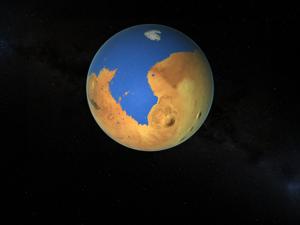
The red planet was half blue, according to space scientists.
A research team using images from cameras on Mars-orbiting spacecraft say it was a “blue planet” around three billion years ago – with an ocean at least as large as the Arctic Ocean.
The international team, led by the University of Bern, discovered structures on Mars that are very similar to classic river deltas on Earth.
A university release explains: “These are traces of rivers that have deposited their sediments into an ocean.”
Previous studies have already provided evidence of oceans and rivers on Mars, indicating a once humid and possibly habitable environment.
Using high-resolution images from various Mars cameras, the researchers have found geomorphological structures near Valles Marineris – the largest canyon system on Mars – that resemble river deltas on Earth. These structures represent the mouth of a river into an ocean.
The University of Bern says: “The new study thus provides clear evidence of a coastline and consequently of an earlier ocean on Mars.”
Ignatius Argadestya, a PhD student at the University of Bern, says: “The unique high-resolution satellite images of Mars have enabled us to study the Martian landscape in great detail by surveying and mapping.
“When measuring and mapping the Martian images, I was able to recognise mountains and valleys that resemble a mountainous landscape on Earth. However, I was particularly impressed by the deltas that I discovered at the edge of one of the mountains.”
Fritz Schlunegger, Professor of Exogenous Geology at the Institute of Geological Sciences at the University of Bern, adds: “Delta structures develop where rivers debouch into oceans, as we know from numerous examples on Earth. The structures that we were able to identify in the images are clearly the mouth of a river into an ocean.”
The University of Bern says the study therefore confirms and proves earlier scientific evidence that there was an ocean on Mars around three billion years ago.
The research results also show that the ocean found was at least as large as the Arctic Ocean on Earth.
Fritz Schlunegger says: “We are not the first to postulate the existence and size of the ocean. However, earlier claims were based on less precise data and partly on indirect arguments.
“Our reconstruction of the sea level, on the other hand, is based on clear evidence for such a coastline, as we were able to use high-resolution images.”