

By Stephen Beech
Astronauts could soon be able to move more freely in space thanks to robotic trousers developed by British scientists.
Not only does the ground-breaking technology have out-of-this-world benefits, but researchers say it could also provide more down-to-earth help for people who need support with their mobility.
The lightweight robotic exosuit is designed to resemble a garment and is mostly made of fabric material, according to a study published in the journal Advanced Science.
Worn underneath a spacesuit, the exosuit features artificial muscles that work automatically to help astronauts reduce muscular fatigue while maintaining natural movements during future missions to the moon and Mars.
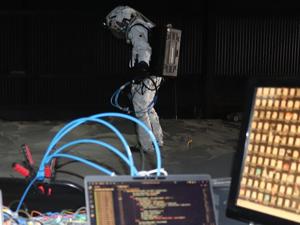
Dr. Emanuele Pulvirenti, research associate in the University of Bristol’s Soft Robotics Lab, travelled to the Exterres CRATER facility – the largest simulated lunar environment in the Southern Hemisphere – at the University of Adelaide in Australia.
The exosuit was put through its paces as part of an international “proof of concept” simulated space mission run by the Austrian Space Forum. D
The mission saw 200 scientists from 25 countries working together on different experiments and operational simulations across four continents and reporting back to the mission control base in Austria.
The ADAMA mission organized by ICEE.space, which Dr. Pulvirenti was part of, was the first time a soft robotic exosuit had been integrated into a spacesuit, and the first field test of its kind.
The experiments evaluated comfort, mobility and biomechanical effects when performing planetary surface tasks such as walking, climbing and load-carrying on loose terrain.
Dr. Pulvirenti handmade the exosuit himself, teaching himself to sew as part of the process.
He said: “Fortunately, my grandmother worked as a tailor and she was able to give me some advice.”
Dr. Pulvirenti developed the lightweight exosuit alongside Vivo Hub colleagues at the University of Bristol.
He explained that the artificial muscles in the suit consist of two layers: an outer nylon layer and an inner thermoplastic layer that allows airtight inflation.
The anchoring components, such as the waistband and knee straps, are made from Kevlar for high strength and tension resistance.
Dr. Pulvirenti said: “The hope is that this technology could pave the way for future wearable robotic systems that enhance astronaut performance and reduce fatigue during extra-vehicular surface activities.
“I would love to continue developing this technology so that it could eventually be tested at the International Space Station.
“It’s exciting that this technology could also potentially benefit people, too.
“This exosuit is assistive, meaning it artificially boosts the lower-limb muscles, but we have also separately developed a resistive exosuit, which applies load to the body to help maintain muscle mass.”
He added: “Our next goal is to create a hybrid suit that can switch between assistance and resistance modes as needed, which could be of great benefit for people in need of support with mobility going through physical rehabilitation.”