

By Stephen Beech
Water in Pompeii’s Roman baths was contaminated, reveals new research.
Limescale deposits in the buried city’s wells, pipes, and bathing facilities show hygienic conditions were poor, say scientists.
Pompeii was Pompeii was covered in several feet of volcanic ash, pumice, and rock fragments following the eruption of Mount Vesuvius in 79AD.
Researchers from Johannes Gutenberg University in Mainz, Germany, have reconstructed the city’s water supply system based on carbonate deposits – particularly the transition from wells to an aqueduct.
Study first author Dr. Gül Sürmelihindi said: “The baths were originally supplied by deep wells with water-lifting devices, and the hygienic conditions in them were far from ideal.
“Over time, however, the water-lifting devices were upgraded through technological developments before being replaced by an aqueduct in the first century AD, which provided more water and allowed more frequent refreshment of water for bathing.”
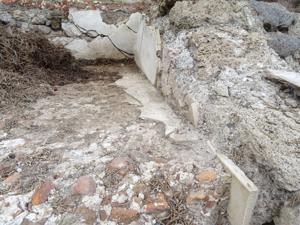
To reconstruct the ancient water supply, Dr. Sürmelihindi and her colleague Professor Cees Passchier used isotope analysis to examine carbonate deposits that had formed in various parts of Pompeii’s water infrastructure – including the aqueduct, water towers, well shafts, and the pools of the public baths.
Dr. Sürmelihindi said: “We found completely different patterns of stable isotopes and trace elements in the carbonates from the aqueduct and in those from the wells.”
Based on the different geochemical characteristics, the team was able to determine the origin of the bathing water and draw conclusions about Pompeii’s water management system and quality.
The findings, published in the journal Proceedings of the National Academy of Sciences (PNAS), showed that the wells tapped into highly mineralised groundwater from volcanic deposits, which was not ideal for drinking purposes.
The discovery fits in with what was previously known.
During the reign of Augustus, the aqueduct was built in Pompeii, significantly increasing the amount of available water for bathing and providing drinking water.
Dr. Sürmelihindi said: “In the so-called Republican Baths – the oldest public bathing facilities in the city, dating back to pre-Roman times around 130 BC – we were able to prove through isotope analysis that the bath water was provided from wells, and not renewed regularly.
“Therefore, the hygienic condition did not meet the high hygienic standards usually attributed to the Romans.”
She says the water was probably only changed once daily, and added: “After all, the baths were supplied by a water-lifting machine, powered by slaves via a kind of treadwheel.”
The researchers also found lead, zinc, and copper peaks in the carbonate deposits which indicates contamination with heavy metals in the baths water.
Dr. Sürmelihindi said: “This suggests that boilers and water pipes were replaced, which increased the heavy metal concentrations.
“An increase in stable oxygen isotopes also shows that the pools in the Republican Baths provided warmer water after the renovation.”
The researchers also found “peculiar, cyclic patterns” in the carbon isotope ratio of carbonate from the wells.
Professor Passchier added: “A possible cause could lie in the fluctuating amount of volcanic carbon dioxide in the groundwater.
“This cyclicity may provide information on the activity of Mount Vesuvius long before the 79AD eruption.”