

By Jack Fifield
Meet the man mapping Britain for Google – on foot.
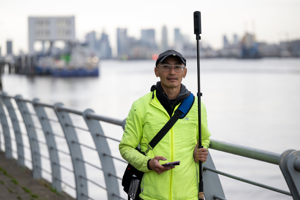
Dr. Uy Hoang, 51, decided to act after realizing he couldn’t see his local town path online and now he is single-handedly mapping Britain’s waterways as a hobby.
He has taken a staggering 300,000 snaps and uploaded them to the online mapping service – making him the most prolific contributor in Britain and ninth in the world, he says.
Starting in 2015, he has spent the last 10 years covering the nation’s rivers and canals – walking an estimated 1,600 miles.
Uy, from London, says he’s covered at least 75% of the nation’s canal network so far.
He spends eight to ten hours a day walking with his $1,000 Insta360 camera to capture the paths Google Street View cars can’t fit down.
The statistician, who works for the University of Oxford, says his hobby was born out of frustration with a lack of street view coverage on his local bike paths.
He said: “Everybody uses Google Maps to try to plan journeys, and I was thinking ‘why isn’t this stuff on Google Maps?’
“It’s obvious you can go down there and photograph it to help people out with their planning. Why have a bad map? It’s like having no map.
“If you have a bad map, you’re led down wrong places, you do incorrect planning, you waste more time.”
When he first started, Uy experimented with different techniques – such as mounting a camera on his backpack while cycling.
But, he quickly realized his best photos were taken while he was walking, holding the camera on a pole above his head.
Now, he says, photos have become almost indistinguishable from Google’s own.
He said: “I was trying all these different techniques to get photos.
“Initially, I thought I needed to use tripods, I was putting the tripod down and I realized that wasn’t scalable, really.
“I tried bicycles, but now I walk everywhere because it allows me to access all the spaces that you can’t with a bicycle.
“I usually start from near a hotel or public transport, and I end from a place where I can get public transport.
“I used to ferry myself to the start and then walk back there, but I realized you can only cover half the distance as you have to walk back.”
Uy says he can only take photographs in summer, as this is when the best quality light is available for the longest amount of time.
He also has to use techniques to prevent fatigue – as he carries his monopod with his hands and holds it up to take photos.
He said: “My approach is to go as lightweight as possible in all the equipment I use as the photoshoots can last all day and take in many miles.
“So, I use a lightweight monopod and keep it close to my body to minimize the amount of weight I am carrying away from my core muscles.
“I also walk fairly slowly and take breaks to rest the limbs.”
His excursions aren’t always a walk in the park either – as fast-flowing water combined with narrow paths can cause danger.
Uy said: “If you’re on an isolated canal, you never know who you could meet.
“They see you wandering around with expensive camera equipment. You’ve got to be careful.
“I’m really mindful of how dangerous these places can be.
“It really dawned on me when I was at the Bristol Basin.
“At low tide, the River Avon is about 20ft below the dock, and underneath is just mud.
“I was standing at the side and nobody was there, because it was six in the morning.
“It was freezing cold – and I thought ‘if I slip, there’s no way anybody’s going to find me.’
“There’s been examples where I’ve fallen into potholes, certainly on the canal – some of the towpaths are really nice, but other areas there are large potholes.
“Often you don’t realize when you’re walking so close to the edge.”
It’s not only people who use Google Maps to get from A to B that find Uy’s photos useful.
Flood risk modellers have got in touch with Uy to tell him that they use his photographs to help plan flood mitigation measures.
Something Uy has been struck by, however, is the extent of pollution floating around on some of Britain’s waterways.
He said: “You see a lot of wet wipes, this sort of gunky, homogenized stuff.
“You see mattresses, Lime bikes, shopping trolleys, fridges, motorbikes, all sorts of weird stuff.
“There are so many pressures on our rivers – not least pollution, but also climate change.
“It’s really important that we start to map them now before change becomes irrevocable.
“It’s something we’re starting to do in the UK, but if you have a look at Google Maps, many, many of the great rivers human civilization relies on haven’t been mapped at all.
“The Nile, the Mekong, the Red River, the Yellow River, the Mississippi – huge chunks, we don’t have any mapping.
“It’s really important we start thinking about how we can get these rivers mapped.”