

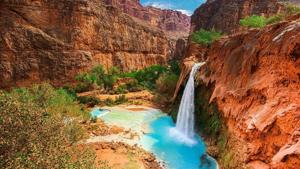
The Havasupai Tribe, steward of one of the Southwest’s most sought-after destinations, announced sweeping changes to its tourism and permit system this week. This marks a notable change in how travelers will access Havasu Falls and Mooney Falls beginning in the 2026 season.
For the first time, visitors will be able to purchase permits before the traditional Feb. 1 on-sale date. This move replaces the lottery system and eliminates the permit transfer board. Tribal officials said the changes are designed to streamline reservations, reduce confusion, and create a more predictable process for travelers planning trips to the remote canyon.
New Early Access Window, No Change in Prices
Under the new system, an “early access” purchasing window will open on Jan. 21, 2026, at 8 am. Arizona time and run through Jan. 31 at 5 pm. During that period, travelers may secure either campground or lodge permits for the upcoming season for an additional fee.
Campground permits will cost $455 per person for a three-night stay, plus a $40 early access fee. Lodge permits, which allow up to four people per reservation, will cost $2,277 for three nights, plus a $160 early access fee. All reservations will be made through a new booking platform at the tribe’s official reservations website.
The traditional Feb. 1 opening date will remain in place, with pricing unchanged from previous years. Beginning at 8 a.m. Arizona time on Feb. 1, campground and lodge permits will be sold at standard rates, without early access fees, until availability is exhausted.
Partial Refund Policy Implemented
Another notable change that many have been asking for is finally happening.
The Supai tribe is introducing a partial refund policy, a first for the Havasupai permit system. Travelers who cancel at least 90 days before the start of their reservation will be eligible for a 50 percent refund of the permit fee, though early access fees will remain nonrefundable.
Refunds will be issued to the original credit card used at the time of purchase.
Cancellations made within 90 days of the reservation start date will not qualify for refunds. However, visitors are still asked to formally cancel their bookings online to notify tribal staff of no-shows. Each permit must be canceled individually to receive any eligible refund.
The tribe is also encouraging visitors to establish a Potential Alternative Trip Leader (PATL) when making reservations. This allows another named individual to check in for the reservation if the original permit holder cannot attend. Alternative leaders must be added at the time of booking.
Despite the added flexibility, the tribe reiterated its prohibition on permit transfers and resale, reinforcing a long-standing policy aimed at preventing secondary markets and ensuring equitable access.
What To Know About Hiking Down to Havasupai
The turquoise blue waters at the bottom of the Grand Canyon have always been an idyllic destination – I first went with my parents when I was a young teenager in the 2000’s.
But the vibrant colors and gorgeous waterfalls went viral on social media, making the small Supai village a global phenomenon. There’s no denying its picture-perfect views.
The 10-mile trail is challenging, but for the most part, quite straightforward. The first two miles drop you into the canyon, where you’ll walk for another 8 miles before reaching the village of Supai.
Here, you’ll check in, get all your passes, and begin the mile hike to the campground. This is also where you’ll encounter the first of many mesmerizing waterfalls.
Preparing for Havasupai
For many, this is their first-ever backpacking trip. I would not recommend that. Backpacking into Havasupai usually totals around 30 miles round-trip, and unfamiliar new gear can lead to blisters, discomfort, exhaustion, or worse.
I strongly suggest doing an overnight trip near your home base to test out gear and familiarize yourself with sleeping outside. Furthermore, you’ll want to spend two to three months training for this trip.
This includes hiking or running multiple times per week, strength training, and carrying weight on your back.
While this is like most other backpacking trips, it’s one with an unusual safety net. You’re not alone, there’s plenty of water to drink, and if you get into trouble, there’s a village with a helicopter less than a mile away, which is why so many first-timers are able to do this trip with no issue.
Treat the area with respect
You are a visitor to someone’s home with an abundance of history. Remember to treat the area with respect, follow Leave No Trace guidelines, and leave your campground better than you found it.
Tens of thousands of people spend time here, and that adds up. If everyone does their small part to make it better, we can keep this oasis as pristine as possible.