

By Stephen Beech
Flowers shape the spread of disease among wild bees, according to new research.
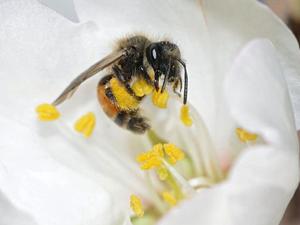
Potentially deadly viruses in the pollinators are closely linked to the flowers they visit and the availability of flowering plants – from the immediate local habitat to the wider landscape, say scientists.
Israeli researchers found that certain floral communities increase the likelihood of virus presence, and that flowers can serve as hubs for virus transmission between wild bees and honey bees.
They say their findings, published in the journal Ecological Applications, suggest that pollinator conservation efforts must consider disease dynamics alongside habitat restoration.
The study also shows that viruses commonly associated with honey bees are also present in wild solitary bees, and that their distribution is strongly influenced by floral communities.
By surveying wild bee populations across multiple sites in a Mediterranean agroecosystem, the research team found that both the diversity of flowers at a site and the availability of floral resources in the surrounding landscape play a “key role” in shaping where and when bee viruses occur.
The researchers focused on mining bees, an important group of wild pollinators, and screened them for several widespread bee viruses.
The results indicate that flowers act as shared meeting points for different pollinator species, creating opportunities for virus transmission.
Certain floral communities were associated with higher likelihoods of viral presence, while landscape-level floral resource availability, extending up to 1,000 metres (0.6miles) from a site, emerged as a particularly strong predictor.
Study leader Idan Kahnonitch said: “Our findings show that flowers are not just food sources for pollinators.
“They also shape disease dynamics within pollinator communities.
“This means that decisions about habitat management and restoration, often focusing actions on the plant communities can have unintended consequences for pollinator health if disease transmission is not taken into account.
“Importantly, the study also found evidence that viruses can be shared between managed honey bees and wild bees, reinforcing concerns about how intensive agriculture and beekeeping may influence the health of native pollinator populations.”
Idan Kahnonitch, a doctoral student under the guidance of Prof. Yael Mandelik at the Hebrew University of Jerusalem, added: “While virus levels in wild bees were generally low, their presence was consistently linked to ecological conditions, especially floral composition and resource availability.”
The research team emphasised that pollinator conservation strategies should move beyond simply increasing flower abundance or diversity.
Instead, they argue for a “landscape-level approach” that considers which plant species are present, how pollinators share floral resources, and how those interactions may affect the spread of disease.