

By Ed Chatterton and Susie Watkins
A “disturbing” boom in the UK exotic animal trade is being fueled by people buying everything from monkeys to mountain lions on social media, charities have warned.
Cruel sellers are flogging wild animals as pets on TikTok, Facebook and Instagram before the creatures end up dumped, neglected or killed.
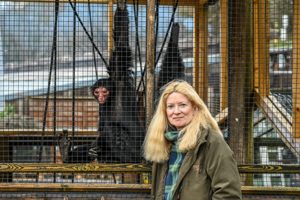
Animal rescuer Lindsay McKenna, who runs Wildside Exotic Rescue, says she’s bombarded with 25 pleas a week from owners desperate to offload the animals they can’t cope with.
She believes too many are unaware of the thriving wild animal pet trade in the UK, which has seen a surge thanks to social media, and the animals are often kept in “appalling conditions.”
Evangeline Button, Senior Scientific and Policy Officer at the RSPCA, said: “Exotic pets aren’t domesticated, so their welfare needs are the same as they would be when living in the wild – meaning they need specialist care.
“Despite this, it’s easy to find these animals for sale online and sometimes owners take them on with little or no information about how to care for them properly.
“It can also be hard to find expert, science-based information on how to care for many types of exotic pet as online sources can be contradictory, or unreliable.
“We know that social media, alongside films and TV, can spark interest in these animals, leading to people acquiring these animals without fully understanding the level of care and commitment involved.
“Online platforms can also glamorize the ease of keeping exotic pets, often misleading people about the reality of keeping them and their specialist welfare needs.
“Exotic pets often end up in our care after people realise they’re not easy to look after, or once the novelty wears off.
“That’s why we want to see stronger regulations that limit the keeping of wild animals as pets to species which are likely to experience good welfare in home environments.”
Charity Born Free say the international trade in wild animals as exotic pets is estimated to be worth billions of pounds annually and involves millions of individual animals.
Lindsay has rescued hundreds of animals from people’s homes up and down the country, 200 of which are now kept on her 60 acre site in Herefordshire.
These include two mountain lions found in a back garden in Manchester, where they lived in a 3m (9ft) long cage built from chicken wire and rotten wood.
She also rescued a Capybara living in a bathtub, a raccoon from a third floor flat and and a marmoset monkey, which was being kept in a hamster cage.
Most recently, she took in a tiny monkey bought off Tiktok after it was paraded online in a pink dress, dressed in nappies and fed marshmallows.
Lindsay said: “We get a hundred requests a month from people who have bought an exotic animal on social media.
“There’s lots of monkeys but also reptiles like snakes and bearded dragons, as well as racoons, foxes and sugar gliders – these are on Tiktok, Facebook and Instagram
“These sellers often dress them up in nappies and give them a bottle – basically trying to sell them as an alternative to a child.
“I easily get 25 requests a week from people who are desperate to get rid of their exotic animals.
“A lot of people buy their animals on a whim from TikTok and Instagram, and then there aren’t very many second chance places for these animals when they change their mind.
“They either get released into the countryside, or killed, or are highly neglected in small cages.
“Many places pose as reputable breeders but they know nothing about true animal welfare and are looking to make money.
“It is a disturbing trend and I have certainly seen a surge recently.
“People need to stop and think and call it out when they see it – buying animals off Tiktok is never a good idea.
“Like many people I wasn’t aware that there was a thriving wild animal pet trade in the UK, which is largely unregulated.
“It is the most highly unregulated, cruel trade.”
Lindsay says they could have 5,000 animals currently with the amount of demand for their services.
She added: “We can only have 200 here, we have to be stricter with animals we take in now to ensure we’re giving all the animals here a great life.
“We have two goals – one is to take in an animal that has come out of the animal pet trade and give them as wild and enriched life as is possible in captivity, and the other is to campaign for tighter regulations in the wild animal pet trade.”
Lindsay says the current legislation on keeping wild animals as pets is very lax.
It is currently legal to keep wild animals as pets, even those considered dangerous, under the Dangerous Wild Animals Act 2026.
She added: “Only about ten of our 43 species need a licence, and the rest are completely unregulated.”
On April 6 this year, new primate legislation will become law, when all primates in England will need to be kept at zoo-level standards, effectively banning the practice of keeping primates as pets.
The Department for Environment, Food and Rural Affairs (Defra) estimates that up to 5,000 primates are kept as pets in the UK.
Lindsay added: “These changes can’t come fast enough and are long overdue.
“The last marmosets that were brought in were bought by her owner wearing a pink dress and nappies, taken off her mother pre-weaning, and was fed a diet of marshmallows and dried fruits.
“Another vet alerted us that parents had bought their son a monkey as a 10th birthday present.
“The monkey was in the boy’s bedroom and the parents didn’t know anything about how to care for the monkey.
“It was in a hamster cage in the bedroom and the child had been feeding it bubble-gum and biscuits.
“The only reason they moved it on was because it badly bit the boy’s fingers.
“The new legislation is welcome but I think you’ll see a lot monkeys being dumped, flushed down the toilet and killed sadly in the short run.
“It will be places like ours having to pick up the pieces but we are all self-funded and have no government help.”
A Defra spokesperson said: “Primates are highly intelligent and complex animals, and new laws mean that where they are kept by private keepers they must be provided with zoo-level welfare standards.
“We urge private keepers to make sure they are licensed and complying with these high welfare standards and we are working with local authorities on how to enforce the new licensing scheme.”
Chris Lewis, Captivity Research Manager at Born Free, said: “Trends in the keeping of wild animals as pets are increasingly shaped by popular culture, social media and films, where novelty and aesthetics are sought after.
“Sudden surges in demand for species less commonly traded can increase pressures on wild populations, with individuals, sometimes illegally, taken from the wild.
“Unfortunately, it is legal to keep, breed and trade almost any wild animal as an exotic pet in the UK, providing appropriate legislation (where necessary) is adhered to by the seller and purchaser.
“The exotic pet trade exposes wild animals to welfare harms at every step of their journey, from possible capture in the wild through transport, sale, and a lifetime of captivity in a domestic environment ill-suited to their complex needs, creating a chain of suffering and premature mortality.”
FOX41 Yakima©FOX11 TriCities©