
By Stephen Beech
Chimps really are “drunken monkeys” – and actively seek out alcohol in their native habitat, suggests new research.
Urine testing confirmed alcohol consumption among wild African chimpanzees with 17 out of 20 containing alcohol byproducts, likely from fermented fruit in their diet.
A breathalyser is impractical for measuring the alcohol intake of chimps in the rain forests of Uganda, so American researchers instead collected urine for analysis.
Doctoral student Aleksey Maro and his adviser Professor Robert Dudley, from the University of California, Berkeley, documented last year that the fruits chimps eat in the wild contain enough alcohol from fermentation to provide around 14 grams per day — the equivalent of two glasses of wine.
To perfect his urine sampling techniques, Maro worked alongside Sharifah Namaganda, a Ugandan graduate student at the University of Michigan, who has experience collecting urine samples for previous projects at the Ngogo chimp study site.
Under her guidance, he gathered forked branches and covered the ends with plastic bags, creating shallow plastic bowls suitable for stealthy sampling.
The research team also collected samples from puddles of urine on the forest floor.
Maro’s 11-day collecting trip last August to Ngogo in Uganda’s Kibale National Park yielded enough urine samples for him and Dudley to fill in a crucial gap in their “drunken monkey” hypothesis — the idea that chimps and probably many animals naturally ingest alcohol in their diet and even seek it out.
Their new findings, published in the journal Biology Letters, show that the urine of most chimps sampled contain a metabolic by-product of alcohol, ethyl glucuronide, that proves they ingest “significant” quantities of ethanol in their diet – likely from fermenting fruits.
Maro said: “We find widespread physiological evidence of the consumption of alcohol by chimpanzees.
“If there’s any doubt about the drunken monkey hypothesis – that there’s enough alcohol in the environment for animals to experience alcohol in a way analogous to humans – it’s been cleared up.”
Dudley added: “It corroborates the inferred ingestion rates that Aleksey derived previously.”
For the earlier study, Maro had collected samples of the many types of fruit chimps are known to eat.
He measured the ethanol concentration within the fruit pulp and estimated how much alcohol an average chimp would consume given known feeding rates.
Of the 20 urine samples from 19 different chimps, 17 tested positive for ethanol.
Eleven samples were tested with strips sensitive to 500 ng/ml or more, with 10 proving positive.
In humans, 500 ng/ml is a level expected after “light” drinking – one or two standard drinks – within the previous 24 hours.
Similar levels would be expected in a chimp that had spent the morning downing slightly fermented fruit.
Dudley said: “The levels are high, and this is a conservative estimate given the time course of exposure through the day.
“In nanograms per millilitre, these are coming in way above some of the clinically relevant and forensically relevant human thresholds.”
The findings showed that males and females alike tested positive for ethanol by-products in urine, and that the negative results came disproportionately from females and juveniles.
Dudley says one possibility is that males hoard the more alcoholic fruits.
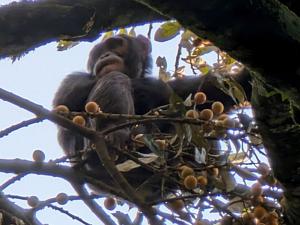
Maro also analyzed the alcohol content of the star apple the chimps were gorging on, thanks to a bumper crop available.
Based on undamaged fruits collected under the trees, the star apples contained less alcohol than the average of many varieties of fruit he had sampled at Ngogo in 2019. Those fruits averaged 0.32% by weight of ethanol.
The star apples, which are about 20% sugar, contained only 0.09% ethanol by weight.
The relatively high levels of ethyl glucuronide in their urine suggest that the chimps were eating kilos of the sweet treat.
One estimate is that chimps eat about 4.5 kilos of fruit daily (10lbs).
Maro said: “Food and alcohol evolutionarily are, as it turns out, very much connected, especially in the lives of chimpanzees.
“It all comes back to the human side: have we evolved predisposed to the consumption of alcohol, based on this ancestral lineage?
“And how did that predispose us to the domestication of alcohol via brewer’s yeast?”
He added: “I have this slide (depicting) every animal besides chimpanzees that I camera-trapped eating those fruits, and it’s everybody out there. So, it’s a widespread phenomenon.”
But Dudley emphasized that the new study doesn’t fill all the gaps in his “drunken monkey” hypothesis.
He added: “The final link here with the drunken monkey hypothesis remains to be shown: that the chimps are selectively consuming fruits with higher ethanol content.
“That hasn’t really been demonstrated for any taxon in the wild.
“So that would be the next future direction on this – to definitively prove the universal hypothesis of attraction to alcohol.”
FOX41 Yakima©FOX11 TriCities©