

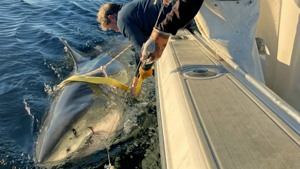
By Michael Lee Simpson
The biggest great white shark ever recorded in the Atlantic has surfaced off North Carolina – giving scientists new information on the secret mating grounds of sharks.
14ft Contender’s tag ‘pinged’ off North Carolina’s Cape Fear coast – sending a signal when his dorsal fin breaks the surface, providing researchers with rare snapshots of his travels.
The 6,053lb predator tracked by OCEARCH pinged off Oak Island, North Carolina, on February 8.
Scientists think sharks mate between January and March, so are closely following the location of sharks who surface during this time to work out where they go to mate, in a bid to decode the reproductive patterns.
Contender’s ping provides a fresh, precise data point on a mature male great white’s return to Cape Fear during the prime January-March mating window, advancing scientists’ efforts to map key Western North Atlantic reproduction sites.
“Contender is a big male, so we’re really interested in where a contender goes at this time of year,” said John Tyminski, senior data scientist at OCEARCH.
“For us, in terms of the science, we’re very interested in what mature males and females are doing because this gives us clues about where mating may be occurring.
This research addresses “one of the big questions that we’ve got, and still trying to figure out where white sharks in the Western North Atlantic mate and in what time of year.”
Currently positioned off Cape Fear, North Carolina, Contender’s presence in these waters during the winter months is particularly significant for researchers studying great white reproduction.
The scientist explained that the environmental conditions and abundant food supply make the area attractive to large sharks like Contender, who “can take even larger prey” and may be “taking advantage of marine mammals, scavenging on dead whales.”
Current evidence suggests mating occurs during the overwintering period, “sometime in this overwintering period, in that sort of January, perhaps to March window,” based on samples showing “males that have mature or motile sperm,” he added.
Tyminski described the research approach as “detective work” and added: “Obviously, just following an animal alone isn’t enough to tell you that, but it’s to say these are clues.
“If we see patterns with other sharks and possibly observations from other people, you’re sort of getting small clues.”
Contender’s impressive frame was measured during his tagging on January 17, 2025, about 45 miles off the Georgia-Florida border.
Since then he has travelled more than 10,000 miles.
“He’s come all the way up into the Gulf of St. Lawrence in Atlantic Canada, and now he’s come back down,” Tyminski said.
FOX41 Yakima©FOX11 TriCities©