

By Dean Murray
Royal and Dutch Marines helped save the life of a climber on Britain’s highest mountain in abysmal conditions.
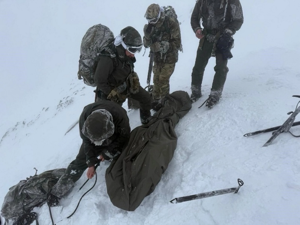
The Royal Navy said the mountaineer had abandoned his climb – or descent – of Ben Nevis on Saturday, Jan 24 and was found curled up in the snow near the summit, as a blizzard raged and temperatures dropped below zero.
“Solid blocks of ice clung to his eyebrows, hat, and gloves – evidence of long exposure to freezing conditions,” said Colour Sergeant McKenzie, from the Royal Marines Reserve. “One walking pole was bent; the other appeared broken or fully collapsed. When spoken to, he revealed that he had become separated from his two friends and had no idea where they were.”
The climbing party – a mix of reservist green berets from Royal Marine Reserves Scotland and their counterparts from the Dutch Korps Mariniers – first helped haul the climber down the slope, then helped him to the foot of the 1,345-metre mountain.
“The wind was biting and relentless, and based on conditions we had experienced earlier in the week during Royal Marines mountain training, we estimated gusts to be around 40â¯mph,” C/Sgt McKenzie added.
“Combined with the summit temperature, this put the wind chill somewhere in the region of –15°C to –20°C, making any exposed skin sting almost instantly.”
The climber did not have crampons so slipped on the icy slope and all the Marines were also beginning to feel the effects of exposure from their time on the mountain.
“To speed things up, one of the Dutch lads took his arm to steady him, but his condition continued to deteriorate,” said C/Sgt McKenzie.
“A second Dutch Marine moved to his other side so the pair could support him fully. This improved his stability, but the awkward spacing led to several crampons being knocked loose, forcing multiple short halts to resecure them.
“During the final stop to fix a crampon, his deterioration became unmistakable. His posture sagged, his coordination faltered, and his responses slowed. Then he said he couldn’t bend his leg, a clear sign that cold, exhaustion, and exposure were now affecting his physical functions. He was entering hypothermia, and it was obvious he would not be walking in the immediate future.”
Using a waterproof bivvy sack, ropes, a mat and a thick jacket – all standard equipment for their exercises – the marines improvised a stretcher to haul the casualty down the mountain.
“If we hadn’t seen him, he certainly would not have survived,” said Sgt Onno Lankhaar, section commander for the Dutch Marines, who were in Scotland for Exercise Highland Warrior, a mountain-training package with RMR Scotland.
Once the group reached the snowline, the climber was well enough to be able to walk independently and was handed over to emergency services as a precaution. His fellow two walkers had made their way safely down the mountain.
C/Sgt McKenzie said: “It was not only a privilege to be invited by the Dutch to join them on their bucket-list climb of Ben Nevis, but also an absolute pleasure to work alongside them throughout the day.
“A major reason we were able to respond as effectively as we did was the excellent training delivered by Sergeant Rich Ely and Major Matt O’Toole in the days leading up to this event. The skills, drills and preparation they reinforced during the week directly enabled us to deal with the situation confidently and safely when it mattered.”