
Democratic presidential contenders test the waters during midterm ‘shadow campaign’
The next presidential election is still two years away, but several prominent Democrats are already positioning themselves for 2028 — using midterm elections as a proving ground to build influence, relationships and national profiles.
California Gov. Gavin Newsom has banked nearly $4 million in his leadership PAC, ready to assist his fellow Democrats in this year’s midterm elections, according to OpenSecrets data.
Close behind him in monetary influence is Illinois Gov. J.B. Pritzker, who has used his personal wealth to finance both his own political career and a host of other Democrats.
And former Vice President Kamala Harris is establishing her own super PAC, Fight for the People, to influence the midterms as she weighs her options for the future.
All three Democrats, widely viewed as potential 2028 presidential candidates, are engaged in what amounts to a shadow campaign — one designed to build influence, accumulate favors and secure future endorsements.
When a would-be presidential contender gives money to a fellow party member, it is less an act of political support than a strategic investment. True, the contribution signals support for a candidate’s success, but it also carries an unspoken expectation: When the donor needs an endorsement, an introduction or a joint appearance down the line, the call will be returned.
Newsom, Pritzker and Harris were in close proximity in late December 2025, when they gathered in Los Angeles to attend the Democratic National Committee’s annual winter meeting. It was a chance to greet state party leaders, make connections and fundraise for the party — all while testing the waters for 2028.
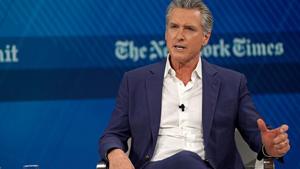
California Gov. Gavin Newsom
Newsom is the early leader for the 2028 Democratic nomination.
A Yahoo/YouGov poll in September 2025 put him at the front of the pack. He garnered 21 percent of support from Democrats while Harris was close behind at 19 percent. New York Rep. Alexandria Ocasio-Cortez, who has been touring the country with Sen. Bernie Sanders (I-Vt.), came in third. Former Transportation Secretary Pete Buttigieg was next, at 10 percent, followed by Pritzker at 7 percent.
Newsom has quietly built a national network that could transition into a presidential campaign. And money plays a huge role in that endeavor.
His leadership PAC, Campaign for Democracy, raised $3.9 million as of Sept. 16, 2025. More will likely be added to his coffers as he continues supporting party members. While he gave very little to Democratic candidates in 2024, he is positioned to do more this year.
Newsom has demonstrated he can be a campaign cash cow. In October 2025, the governor’s effort to pass a redistricting measure in his state raised so much money and was so far ahead in the polls, he decided to simply stop fundraising.
“You can stop donating now,” he told donors in an email.
At the time, the ballot measure campaign had $37 million in the bank after raising a total of $114 million. Overall, Newsom’s PAC brought in $114 million, or about 67 percent of the funds on the support side, according to state filings, and the measure passed, giving Democrats the opportunity to pick up additional seats in the California delegation.
It also built him a lot of goodwill. The proposition was a response to off-cycle redistricting efforts in Texas that redrew congressional lines to favor Republicans. California’s new map will be in effect until 2030 — when the country engages in what is normally a once-a-decade redistricting process — and is estimated to give Democrats an additional five House seats.
Newsom said he would decide his presidential plans this year, telling “CBS News Sunday Morning” that he would determine whether to run for president sometime after the midterms.
“Yeah, I’d be lying otherwise,” Newsom said after he was asked whether he would consider a bid.
Former Vice President Kamala Harris
Harris announced in 2025 that she would not run for governor of California, where Newsom is up against term limits. But she left open the possibility of another presidential bid, even though she was coy when questioned by The New York Times.
“It’s three years from now,” she said in a November 2025 interview. “I mean, honestly.”
However, she did reveal she planned to stay involved in Democratic politics. And she would do so by employing one of the strongest tactics out there: forming a political action committee, the Fight for the People PAC, to help Democratic candidates in the midterm elections.
And she sent her first fundraising appeal since the 2024 election on Monday, Dec. 29, 2025, asking supporters for donations ahead of the end-of-the-year deadline.
“I have decided to start a PAC — Fight for the People PAC,” she wrote in the text message. “I am going to travel, speak out, and help elect Democrats everywhere, and I cannot do this alone.”
“Everyone will be watching, and I hope to file a big report,” she added as she appealed for donations.
Still, many Democrats remember the pain of the 2024 election. Harris’ loss after raising $1.15 billion in 15 weeks has left many of the party’s top donors angry, raising questions about how much money she could raise to aid her cause. And the Democratic National Committee announced on Dec. 18, 2025, that it is not going to release a promised report documenting the party’s failure to win the 2024 presidential election. Some Democrats say that the decision unfairly benefits Harris heading into the next election.
Illinois Gov. J.B. Pritzker
Pritzker has one quality that makes other candidates jealous: When he needs money, he doesn’t have to dial donors begging for funds. He simply writes himself a check.
He is the wealthiest officeholder in the United States, other than Donald Trump. The Pritzker family’s chain of Hyatt Hotels has left him with a personal fortune of $3.9 billion, according to Forbes.
He has poured more than $508 million into state and federal elections since 2015, including at least $348 million for his campaigns, according to a Washington Post analysis.
And he’s given to a who’s who of candidates in the Democratic Party, including Hillary Clinton, in addition to donating to state parties and Democratic-leaning PACs, an OpenSecrets analysis found.
Pritzker established Think Big, a 501(c)(4) supporting efforts to retain abortion rights. That group has made independent expenditures in support of Democratic candidates who back reproductive rights.
Other contenders
Of course, there are more Democrats considering a White House bid.
Pennsylvania Gov. Josh Shapiro — who was a contender to be Harris’ running mate before she picked Minnesota Gov. Tim Walz — is one name being tossed about.
He’ll spend this year running for a second term as governor and trying to flip as many as four congressional seats in his home state.
Pennsylvania is a must-win state for any presidential candidate. If Shapiro can demonstrate his ability to deliver his home state by first delivering electoral wins for Democrats in the midterms, he will have major influence in the 2028 race.
And he can lean on his connections to some of the Democrats’ biggest donors, including Jennifer Duda, George Soros, Reid Hoffman and Michael Bloomberg, all of whom have given to his past campaigns, according to his state filings.
Buttigieg is also testing the waters, holding town hall meetings in key states like Iowa and doing podcast interviews with influencers.
He raised $15 million for the Biden-Harris ticket in 2024 and will likely help Democrats fundraise this year.
Ocasio-Cortez has high name recognition and has been outraising her fellow lawmakers. Her campaign took in $15.4 million in the first half of 2025 and had $9.8 million on hand at the end of June. Her “Fighting Oligarchy” tour with Sanders has many political strategists speculating that she might run for governor of New York or the White House.
This story was produced by OpenSecrets and reviewed and distributed by Stacker.