
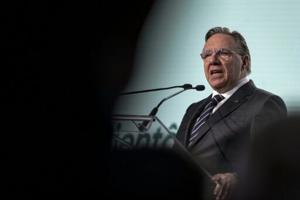
Quebec’s premier announced plans to resign on Wednesday, months ahead of an election that could see a separatist party return to power in the French-speaking province.
Francois Legault, a successful airline entrepreneur before entering politics, charted a new path in Quebec, where power had for decades swung between the federalist Liberal Party and secessionist Parti Quebecois.
Legault had previous ties to the separatist movement, but his Coalition for the Future of Quebec (CAQ) did not move to organize a referendum since coming to power in 2018.
He has maintained that he views Quebec as a “nation,” which must vigorously defend the French language and its distinct culture but that independence was not immediately viable.
He was comfortably re-elected as premier in 2022, but his poll numbers have since plummeted.
“I can see that many Quebecers are currently looking for change, including, among other things, a change of premier,” Legault told reporters in the provincial capital, Quebec City, on Wednesday.
He said he would resign “for the good of the party and for the good of Quebec,” as soon as the CAQ chooses a new leader.
A resurgent Parti Quebecois (PQ) has consistently led the polls ahead of a provincial election set for October.
The provincial Liberal Party has made efforts to gain ground and hoped that a new leader, a former federal cabinet minister in ex-prime minister Justin Trudeau’s government, would bolster its fortunes.
But that leader, Pablo Rodriguez, resigned abruptly in December, under fire over alleged irregularities in his nomination battle.
Despite the PQ’s vow to organize a new referendum, it remains unclear if a majority of Quebec voters want to separate from Canada, especially during a period when the provincial economy is facing unprecedented economic threats from US President Donald Trump’s trade war.
A December poll from Qc125 put support for an independent Quebec at just 35 percent, figures broadly in line with data collected throughout 2025.
Quebec separatists have been defeated in two previous referendums, in 1980 and an extremely close 1995 vote.
gen/bs/jgc