
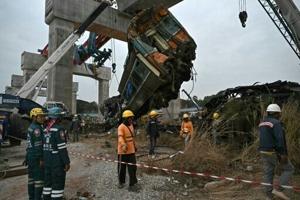
A crane at a China-backed high-speed rail project in Thailand collapsed onto a passenger train on Wednesday and caused it to derail, killing at least 32 people, authorities said.
The massive crane’s broken structure was left resting on giant concrete pillars, while smoke rose from the wreckage of the train below, footage from the scene verified by AFP showed.
The company contracted to build the section of the high-speed rail where the crane fell, Italian-Thai Development — one of the Thailand’s biggest construction firms — has seen a series of deadly accidents at its sites in recent years.
The firm expressed condolences for those killed and the dozens injured, saying in a statement it would “take responsibility for compensating the victims’ families and covering medical expenses for those injured”.
Dozens of rescuers worked into the evening, using other cranes to remove wreckage and searching for missing people in the tilted carriages in Nakhon Ratchasima province, northeast of the capital Bangkok.
Mitr Intrpanya, who was at the scene, said he heard a loud noise “like something sliding down from above, followed by two explosions”.
“When I went to see what had happened, I found the crane sitting on a passenger train with three carriages,” the 54-year-old told AFP.
“The metal from the crane appeared to strike the middle of the second carriage, slicing it in half.”
The Thai health ministry said 32 people were killed, three were missing and 64 were hospitalised including seven in serious condition.
– ‘Only company in charge’ –
The accident happened at a construction site that is part of a more than $5 billion project backed by China to build a high-speed rail network in Thailand.
It aims to connect Bangkok to Kunming in China via Laos by 2028 as part of Beijing’s vast Belt and Road infrastructure initiative.
Engineering consultant Theerachote Rujiviphat, an adviser on the high-speed project, told AFP Italian-Thai Development was solely responsible for the crane collapse.
Theerachote, from the China Railway Design Corporation, said the launching crane that fell onto the existing rail tracks also belonged to Italian-Thai.
“It is the only company in charge. A similar accident also happened a few years ago under their responsibility,” Theerachote added.
Thai Prime Minister Anutin Charnvirakul said authorities must determine the cause of the crane collapse and hold those responsible to account.
“These kind of incidents happen very regularly,” he told reporters in Bangkok.
“I have heard that it is the same company (involved in previous accidents). It is time to change the law to blacklist construction companies that are repeatedly responsible for accidents.”
– Deadly accidents –
Italian-Thai Development and its director were among more than 20 people and firms indicted in August last year in a case linked to the collapse of a Bangkok high-rise in an earthquake. The collapse killed around 90 people, mostly construction workers.
Five people were killed and 24 others were injured in March when a crane collapsed at a highway construction site, a joint venture including Italian-Thai.
In 2017, a crane used in the construction of Bangkok’s elevated rail system by the firm collapsed in front of a Buddhist temple, killing three construction workers, according to local media.
In a similar incident two years earlier, an Italian-Thai crane fell and crushed two cars in front of a Bangkok railway station, injuring one person.
The Nakhon Ratchasima provincial public relations department said Wednesday that the crane collapsed onto a train travelling from Bangkok to Ubon Ratchathani province, “causing it to derail and catch fire”.
Transport Minister Phiphat Ratchakitprakarn said 195 people were on board.
Thailand has around 5,000 kilometres (3,107 miles) of railway but the run-down network has long driven people to favour travel by road.
Upon completion of the 600-kilometre high-speed railway, Chinese-made trains will run from Bangkok to Nong Khai, on the Mekong River border with Laos, at up to 250 kilometres per hour.
In 2020, then Thai prime minister Prayut Chan-o-Cha, who pushed closer ties with Beijing, signed a deal for Thailand to cover all expenditures for the project, while using China-advised technology.
China’s foreign ministry spokeswoman Mao Ning said Wednesday that Beijing “attaches great importance to the safety of this project and its personnel”, and expressed the nation’s condolences.
burs-tak-pk-tp/sco/ami