

By Michael Lee Simpson
A 12-foot, 1,000-pound shark is now traveling unusually close to Alabama shores.
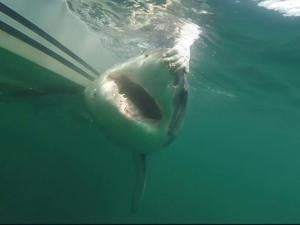
Female great white shark Ernst has traveled thousands of miles from Nova Scotia to waters just off Gulf Shores, Alabama.
Researchers say her location – identified when her tracker ‘pinged’ as she surfaced on January 24 – marks one of the westernmost points recorded for great white sharks in the Gulf and is atypical behavior in their data.
She is hanging out just off The Chandeleur Islands – a chain of barrier islands approximately 50 miles long, located in the Gulf of Mexico, forming the easternmost point of Louisiana.
Scientists view her presence as a positive indicator of ocean health and biodiversity in the waters of Alabama, Louisiana, and Florida.
Ernst’s remarkable journey began in October 2025 when she was tagged by OCEARCH researchers in Nova Scotia’s Mahone Bay region.
After completing her summer and fall residency in Canadian waters, the apex predator embarked on an epic coastal migration that has captivated marine biologists.
“She cut right over to lower Maine from Nova Scotia, migrated right down the coast, and has moved around Miami and the Keys and all the way beyond the Florida Panhandle,” said Chris Fischer, founder and expedition leader of OCEARCH.
The shark is now positioned just off the Gulf Shores region of Dolphin Island, Alabama, marking one of the westernmost points researchers have documented for great white sharks in the Gulf of Mexico.
What makes Ernst’s current location particularly significant is her proximity to shore in Alabama waters – a behavior that Fischer describes as “kind of unusual” for the research team’s historical data sets.
“She has really moved into one of the farther parts of what we see them as moving west,” Fischer said, explaining that while OCEARCH has tracked sharks venturing further west before, “the majority of the sharks, this is pretty far reach.”
Fischer emphasized that great white sharks are selective about their habitats, seeking areas rich in marine life and biodiversity.
“It’s kind of unusual to see her so tight to the beach there, which is a great sign for the region because this is a signal that there’s a lot of life and a lot of biodiversity,” Fischer said.
The area where Ernst is currently located is a unique convergence point where the waters of Alabama, Louisiana, and Florida meet, creating a vibrant marine environment.
Fischer stressed the significance of Ernst’s presence as an environmental indicator.
“When these white sharks cruise into an area like this that’s being managed by the state of Alabama, the state of Louisiana, and the state of Florida, coming together here in a real small area, you start to see these white sharks showing up there,” he said.
“That means they’re all coming together and they’re enjoying great success.”
The researcher noted that great white sharks are discerning in their habitat selection, avoiding compromised ocean environments.
This makes Ernst’s choice to linger in Alabama waters particularly meaningful for conservation efforts and marine management in the Gulf region.
While OCEARCH regularly tracks white sharks entering the Gulf of Mexico and traveling along Florida’s west coast, Ernst’s westward journey into Alabama and Louisiana waters represents the outer limits of the typical great white shark range in the Gulf.
“These white sharks don’t come where the ocean is highly compromised,” Fischer said, describing Ernst’s presence as “an excellent sign for the management in the region.”